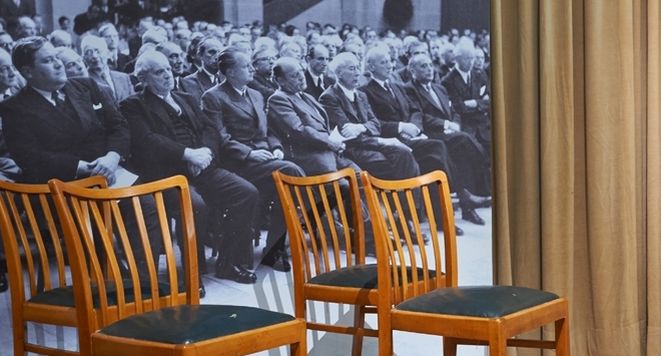
The road to becoming a modern research museum was a long one: Museum Koenig Bonn looks back on an exciting history that is closely interwoven with the history of the Federal Republic of Germany.
Alexander Koenig
Our museum was founded by the Bonn-based private scholar Alexander Koenig (1858-1940) as a private research and exhibition institute. He came from a German family that settled in St. Petersburg, Russia, in the late 18th century and specialised in the sugar industry and sugar trade.
From laying the foundation stone to the Basic Law
The foundation stone for today's museum building was laid in 1912. However, due to the turmoil of the First World War and the politically and economically difficult years that followed, the inauguration could not take place until 1934. In 1929, Alexander Koenig transferred his museum to the Prussian government, which was administering the Rhineland at the time.
The federal giraffe
Every child loves giraffes. At the zoo, in the museum or perhaps even in nature, we stand in awe in front of this huge animal. And despite their long necks, giraffes only have six cervical vertebrae - like almost all mammals. Males can reach a height of almost six metres and weigh up to 2,000 kilograms; add to this the unusual pattern, the long legs and the particularly long neck - the giraffe is truly unique in the animal kingdom! It is understandable that Alexander Koenig (1858-1940) also wanted to own this special animal species for his natural history museum in Bonn to present it to visitors in the central atrium.